

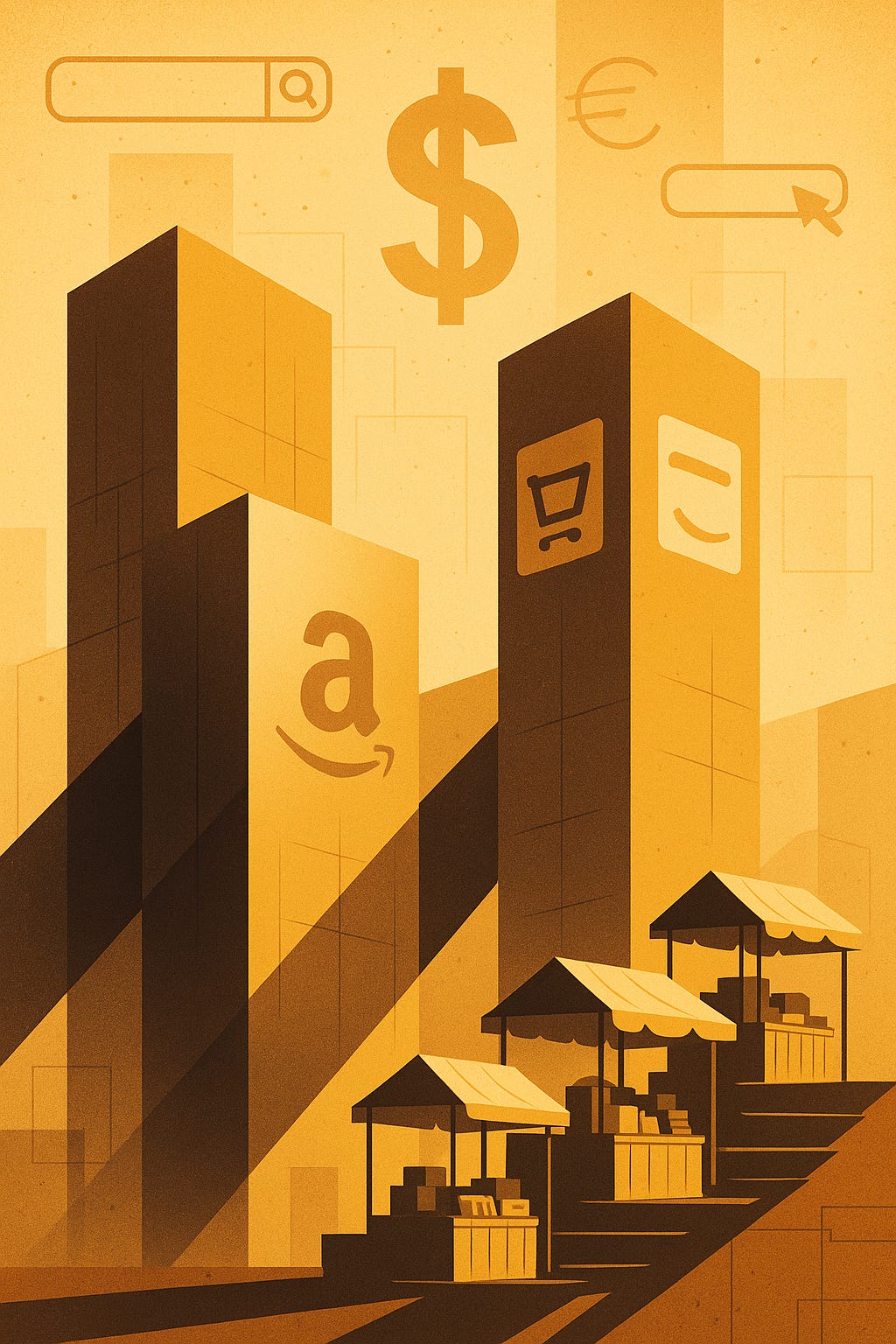
Over the past decade, e-commerce has shifted from convenience to essential infrastructure. But as platforms gained scale, a deeper imbalance emerged. Marketplaces like Amazon, Flipkart, and others no longer simply host sellers they increasingly shape search, visibility, pricing, and even product selection. In the process, the line between platform and retailer has blurred around the world.
This tension has now become a global economic stress signal. Governments in the United States, the European Union, and India are intervening as platforms use their dominance to push private-label products, extract more from sellers, and influence what consumers ultimately buy.
This article examines how the world’s largest retail platforms are transforming from intermediaries into economic gatekeepers and what that means for competition, small businesses, and consumer choice.
Macro Signals
United States Marketplace dominance and ad-driven search economics
In the U.S., the Federal Trade Commission and 17 state attorneys general have accused Amazon of maintaining monopoly power through search manipulation and self-preferencing. The FTC’s case argues that Amazon:
Places its private-label items at the top of search results
Penalizes sellers who offer lower prices anywhere else
Forces sellers to purchase advertising just to maintain visibility
Uses “dark patterns” to make Prime cancellation difficult
Internal documents referenced in the case describe tactics such as “search seeding,” which pushes Amazon-owned products to the top, and “Project Nessie,” an algorithm alleged to raise prices when competitors followed Amazon’s adjustments.
Meanwhile, Amazon’s real profit center is not retail but advertising. The company generated $15.7 billion in advertising revenue in a single quarter in 2024 more than YouTube during the same period. This creates a loop where sellers lose visibility to Amazon’s private labels and must buy ads simply to regain their prior position, driving up operating costs across the marketplace.
The U.S. environment shows how digital platforms can tax commerce by monetizing control over discovery.
European Union - The Digital Markets Act and enforced neutrality
Europe has taken a regulatory approach to breaking the link between marketplace and merchant. Under the Digital Markets Act, platforms deemed “gatekeepers” including Amazon, Google, and Meta must:
Avoid self-preferencing their own goods
Provide ranking transparency
Stop using third-party seller data to compete against sellers
Allow equal access to platform data
This effectively forces Amazon to maintain a structural separation between its marketplace operations and its private-label initiatives within the EU.
The DMA signals that the future of digital commerce in Europe requires competitive neutrality, not vertically integrated marketplaces that own both the search bar and the top result.
India - strongest push for marketplace and seller separation
India has introduced the most aggressive rules globally to prevent platforms from acting as retailers. FDI regulations for e-commerce require:
A foreign-funded marketplace cannot own inventory
A platform cannot sell goods from its own associated enterprises
Marketplaces cannot imply that products offered for sale are from the platform itself
India has enforced these rules with large-scale investigations and legal actions.
Recent examples include:
Myntra (2025)
Reuters reported that India is investigating Myntra, owned by Walmart, for breaching foreign investment rules by operating too close to a retailer rather than a marketplace. India’s rules require strict independence between platform and seller.
Amazon and Flipkart warehouse raids (2025)
Government agencies seized products for violating quality control and regulatory standards and questioned whether certain “preferred sellers” were effectively acting as conduits for the platform’s own inventory.
Delhi High Court rulings
The court ordered Amazon, Flipkart, and other platforms to remove listings that violated direct-selling rules (such as unauthorized sales of Amway products) and enforce the separation of marketplace and brand.
In practice, India is doing what the U.S. is litigating and the EU is regulating demanding a clear boundary between platforms and sellers.
Sector Spotlight - Private Labels and the Economics of Visibility
Private labels used to be simple: offer cheaper alternatives to branded goods. But in digital marketplaces, private labels are now a strategic tool.
Platforms have three major advantages:
They control search rankings
They pay no advertising fees for their own brands
They have access to seller and buyer data that others cannot see
This allows them to identify high-margin categories, copy successful products, and promote their own versions above seller offerings. Amazon Basics is the most famous example, but India’s Flipkart, Myntra, and JioMart have also expanded private-label lines in fashion, electronics, and groceries.
The economics are clear: platforms do not need to earn margins on private labels. They only need those products to create pressure so that sellers spend more on ads.
Implications
For sellers
Third-party sellers face rising economic pressure:
Combined platform fees and ad costs can reach 50–60% of revenue
Ranking losses force higher ad spending
Competition with platform-owned brands reduces category profitability
Dependency on a single marketplace increases business fragility
Many sellers now describe the environment as a “pay-to-be-seen” marketplace.
For consumers
The impact extends beyond sellers:
Sponsored listings inflate prices
Lower-quality private-label goods can appear above better-rated products
Cheaper alternatives are hidden deeper in search results
Search badges can mislead shoppers into selecting platform-preferred items
Consumers assume they are seeing the best deal, but they are often seeing the most profitable result for the platform.
For the global economy
The rise of platform-controlled markets has broader implications:
Higher barriers to entrepreneurship
More concentrated retail power
Increasing dependence on retail media advertising
Divergent regulatory responses across major economies
Supply-chain consolidation around platform-linked sellers
Platforms are evolving from marketplaces into economic actors that influence discovery, pricing, and competitive outcomes.
Conclusion
Across the U.S., Europe, and India, a clear pattern is emerging. Platforms that began as neutral intermediaries now operate as gatekeepers with deep incentives to prefer their own products and extract more from sellers. The world’s largest economies are responding through lawsuits, structural regulations, and direct enforcement.
As e-commerce becomes the backbone of global retail, the distinction between marketplace and merchant is no longer a technical detail. It is now a defining economic issue that shapes competition, small-business survival, and consumer choice. The next phase of digital commerce will depend on whether platforms accept a future defined by neutrality or continue to reshape markets according to their own incentives.