


Most people still talk about AI agents as if the model is the whole story.It is not.
The model is the engine. The real leverage comes from the system around it: prompts, skills, plugins, MCPs, connectors, hooks, scripts, permissions, and review loops. That middle layer is where serious work either becomes repeatable or collapses back into copy-paste chaos.
This is the part many people miss. They see a smart model and assume the work should magically happen. Then they spend hours writing the same long prompt, pasting the same context, checking the same output, fixing the same mistakes, and wondering why AI still feels powerful but not operational.
The deeper issue may be that they are using the model, but they have not built the harness.
The Agent Is Not Just The LLM
A useful way to think about an AI agent is not as a brain floating in isolation. It is closer to a system wearing a mech suit.
The LLM provides reasoning, language, planning, and judgment. But the suit around it determines what it can access, what rules it follows, what tools it can use, what gets checked, and what must go back to a human before the final call.
That suit is the scaffolding.
For casual users, this layer feels abstract. For engineers, the terms are familiar: prompts, skills, MCPs, connectors, hooks, scripts, plugins. But for most teams, this is still a foggy middle layer between “the model is smart” and “the work got done.”
That fog matters. If people cannot name the parts of the system, they cannot design better workflows.
Prompts Are For One-Off Work
A prompt is still useful. It is just not the right place to put everything.
A prompt works when the task is temporary, specific, and unlikely to repeat. You need a one-off summary. You need a quick rewrite. You need a temporary analysis with context that only matters today. That is prompt territory.
The problem starts when people turn prompts into giant containers for reusable work. They keep stuffing in process, style rules, examples, constraints, team preferences, validation steps, and data instructions. Eventually the prompt becomes a fragile operating manual that has to be pasted again and again.
That is not leverage. That is manual labor disguised as AI adoption.
Skills Are For Repeatable Process
A skill is where reusable knowledge starts to become operational.
A skill tells the model how to perform a repeatable kind of work. It can encode your house style, your review method, your writing pattern, your pull request checklist, your sales note structure, your editorial process, or your support workflow.
The important distinction is this: a prompt is for a moment. A skill is for a pattern.
If you repeatedly ask the model to do the same kind of work, you probably do not have a prompting problem. You have a packaging problem. The process should be extracted from the chat and turned into a reusable skill.
This is where AI starts to feel less like a clever assistant and more like an operating layer.
Plugins Package A Whole Workflow
A plugin is bigger than a skill.
A skill says, “Here is how we do this work.” A plugin says, “Here is the workflow package with the instructions, tools, data access, assets, scripts, permissions, and checks needed to get this done.”
That distinction matters. Real enterprise work rarely lives inside one prompt or one instruction file. It lives across systems. The agent may need context from Slack, documents from Google Drive, tickets from Jira, data from Salesforce, code from GitHub, charts from a dashboard, and a final review step before anything ships.
That is plugin territory.
The app store analogy is too small. Plugins are not just cute add-ons. They are workflow containers. They let teams package repeatable operational behavior so other people do not have to reconstruct the same setup manually.
MCPs And Connectors Are How Agents Reach Work
MCPs and connectors are access points.
They let the agent reach the systems where work actually lives. A connector may pull from a CRM, a repo, a spreadsheet, a calendar, a design file, or an internal database. Without that access, the model is often reasoning from stale or manually pasted context.
But an MCP is not the same thing as a plugin.
A plugin can contain an MCP or connector, but the connector is only one part of the workflow. The plugin may also include skills, scripts, assets, metadata, and review logic. The connector gets the data. The workflow decides what to do with it.
That is a critical distinction.
Scripts And Hooks Are For Things You Should Not Trust The Model To Remember
Some parts of a workflow should not be probabilistic.
If code needs formatting, run a formatter. If JSON needs validation, validate it. If tests need to pass, run the tests. If a schema has a required structure, check it with a script. If a security rule must be enforced, do not rely on the model remembering it.
This is where hooks and scripts matter.
A good agent system does not ask the model to “be careful” about everything. It separates judgment from verification. The model can reason, draft, plan, and adapt. Scripts should verify the deterministic parts.
That is how agent workflows become more reliable.
The Simple Mental Model
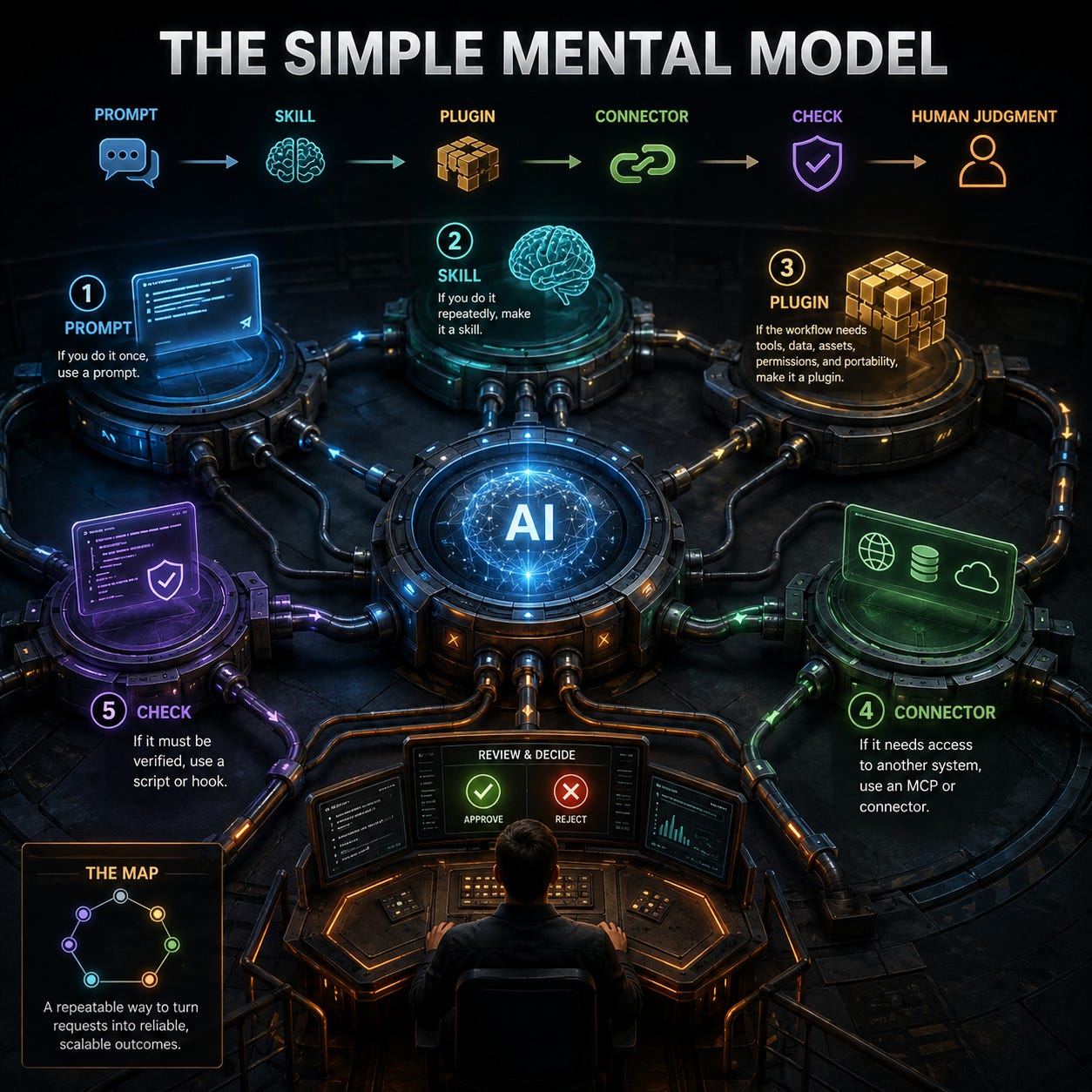
If you do it once, use a prompt.
If you do it repeatedly, make it a skill.
If the workflow needs tools, data, assets, permissions, and portability, make it a plugin.
If it needs access to another system, use an MCP or connector.
If it must be verified, use a script or hook.
If the final call requires judgment, keep a human in the loop.
That is the map.
The Real Skill Is Drawing The Boundary
The highest-value work is not simply knowing these terms. It is knowing where one workflow ends and another begins.
This is where many teams get stuck. They either make everything a prompt, which creates repetitive manual work, or they make everything one giant plugin, which creates an overbuilt mess. The real skill is boundary design. A customer support workflow, for example, may not be one workflow. Refunds, account activation, billing upgrades, technical troubleshooting, and escalation review may each deserve separate units. Each has different data needs, risk levels, permissions, and validation steps.
The same applies to engineering, marketing, finance, operations, and compliance. The question is not “Can AI do this?” The sharper question is “What is the right unit of repeatable work?”
That is where operational leverage begins.
The Enterprise Implication
Most enterprises are still underestimating this layer.
They are buying models, running pilots, and asking employees to “use AI more.” But the actual bottleneck is often not model intelligence. It is workflow architecture. People do not know what should become a prompt, what should become a skill, what needs a connector, what requires deterministic validation, and what should remain human-owned.
This suggests the next phase of AI adoption will not be won by teams that merely have access to better models. It will be won by teams that can turn messy work into well-bounded, reusable agent workflows.
The infrastructure layer is becoming the product.
Conclusion
AI agents are not magic workers. They are systems.
The model matters, but the surrounding scaffolding determines whether the work becomes repeatable, trustworthy, and scalable. Prompts, skills, plugins, MCPs, connectors, hooks, scripts, and human review are not competing ideas. They are different layers of the same operating system.
The mistake is treating the LLM as the whole product. The opportunity is building the mech suit around it.