

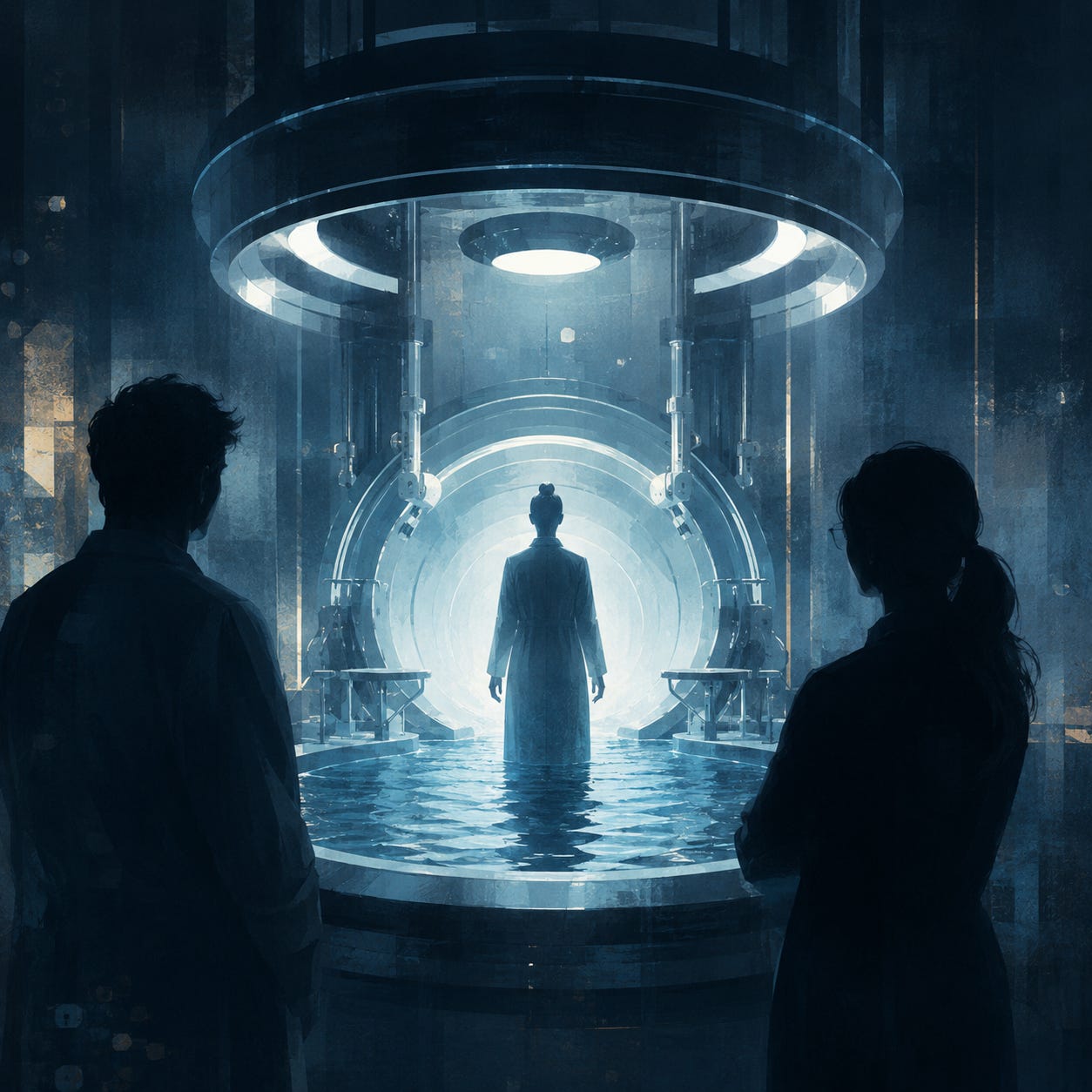
The weakest version of the Midjourney Medical story is the one the internet immediately wanted to fight about: will a 60-second ultrasound scanner replace MRI?
Probably not. At least not from what has been shown so far.
That framing is too narrow, too early, and too easy to dismiss. MRI, CT, ultrasound, and X-ray are not interchangeable products in a consumer category. They are different physical modalities with different strengths, failure modes, clinical uses, and safety tradeoffs. A water-based ultrasonic scanner cannot simply be declared “the new MRI” because a concept video looked beautiful.
But the stronger story is more interesting.
AI-native medicine is moving from software into instruments. The same companies, investors, and builders who spent the last few years turning models into chatbots, coding agents, image generators, and research assistants are now moving down the stack into sensors, imaging systems, lab workflows, biomedical research agents, and physical infrastructure.
That is the part worth paying attention to.
The scanner fight is really a stack fight
Midjourney’s announcement was strange because it violated the category people had placed the company in. Midjourney was supposed to be an AI image company. It made synthetic images from prompts. It was part of the creative AI wave.
Then it announced Midjourney Medical: a proposed full-body ultrasonic scanner built around water immersion, hundreds of thousands of sensors, large-scale reconstruction, and a spa-like user experience. The company described a future where internal body data becomes faster, cheaper, more frequent, and more longitudinal.
That is why the reaction was so sharp.
Doctors saw medical claims arriving before medical evidence. Radiologists saw ultrasound being compared to MRI without the normal burden of proof. Engineers saw an ambitious hardware and compute problem. Wellness optimists saw a path toward routine body monitoring. Critics saw Theranos-shaped shadows. The debate quickly became tribal: tech people versus medical people.
That framing is lazy.
The actual conflict is not between doctors and engineers. It is between two different operating systems. Medicine runs on evidence, liability, regulation, clinical context, and patient outcomes. AI companies run on iteration speed, product demos, scale curves, and belief that compute can unlock new capability. Both cultures are useful. Both can be dangerous when isolated.
A medical scanner cannot be evaluated like a new image model. But a new imaging platform should also not be dismissed merely because it came from outside the usual medical device establishment.
Doctors are right about evidence
The medical criticism should not be waved away.
Ultrasound has real physics limitations. Bone, air, depth, tissue interfaces, and body habitus all matter. A scan that works well for body composition or certain soft tissue structures may still be weak for brain, lung, bone, or small lesions. The question is not whether the reconstruction looks impressive. The question is what it can reliably see, what it misses, and how often it creates false confidence.
Screening is an even bigger issue.
The public often assumes that finding disease earlier is always better. Medicine learned the harder lesson. Screening healthy people can detect harmless abnormalities, uncertain lesions, and incidental findings that trigger anxiety, repeat imaging, biopsies, procedures, and cost without improving survival. More data is not automatically better care.
This is where radiologists are not being obstructionist. They are defending the clinical burden of proof. A scanner used for wellness tracking is one thing. A scanner used to suggest disease, triage risk, or guide treatment is something else entirely.
The right medical question is not: “Is this futuristic?”
The right question is: “Does this change management and improve outcomes?”
Until that is answered, Midjourney Medical is not a diagnostic revolution. It is an ambitious research and product thesis.
Builders are right about the direction
The builders are also not wrong.
Healthcare does need better instruments. The current system is expensive, episodic, fragmented, and reactive. Many people interact with medical imaging only after symptoms appear, after risk accumulates, or after a physician has enough reason to order a study. That is rational under the current cost and evidence structure, but it also means medicine often sees the body in sparse snapshots.
The long-term opportunity is longitudinal measurement.
If a low-risk scan could reliably track body composition, visceral fat, fatty liver trends, muscle loss, organ volume changes, vascular patterns, or other measurable signals over time, that could become useful. Not as a replacement for doctors, but as an input for doctors. Not as a consumer diagnosis engine, but as a monitored data layer.
That is the real product thesis hiding beneath the hype: medicine may move from episodic imaging to persistent measurement.
This is not limited to Midjourney. NVIDIA’s BioNeMo push points in the same direction from the research side. The company is packaging biomedical models, genomics tools, protein design workflows, molecular screening, scientific agents, and accelerated computing into a toolkit for life sciences. That is not a chatbot story. It is infrastructure for scientific work.
Put Midjourney Medical and BioNeMo next to each other and the pattern becomes clearer.
AI is moving into the operating layer of science and medicine.
The new medical stack
The old AI-in-healthcare story was mostly about software sitting on top of existing systems. Summarize a chart. Draft a note. Read an image. Answer a patient message. Improve coding. Automate a back-office workflow.
The next version goes deeper.
It touches sensors, scanners, wet labs, clinical research, molecular design, trial operations, genomics pipelines, imaging reconstruction, and longitudinal data systems. It does not merely interpret the output of medical infrastructure. It starts changing the infrastructure itself.
That creates a different kind of business problem.
A company entering this layer cannot behave like a pure software startup. It needs clinical validation, regulatory strategy, safety case design, physician adoption, malpractice awareness, reimbursement thinking, and institutional trust. Distribution is not just app downloads. It is health systems, regulators, insurers, researchers, clinicians, and patients.
At the same time, incumbent medical institutions cannot assume all serious tools will come from inside the traditional device pipeline. Compute is now a design material. AI reconstruction, cheaper sensors, better chips, and agentic research workflows may make previously impractical systems more plausible.
The winners will likely be hybrid organizations.
They will have engineering ambition and medical humility. They will move fast in the lab and slowly at the clinical boundary. They will use consumer-grade design without pretending that healthcare is consumer software. They will build evidence as part of the product, not as a public relations afterthought.
The culture war is the tax
The online fight around Midjourney Medical showed the predictable failure mode.
Tech optimists acted as if skepticism was just doctors protecting turf. Some medical voices acted as if the builder class had no right to touch serious healthcare problems. The result was noise instead of useful evaluation.
That is the wrong equilibrium.
Doctors do not need to accept claims without data. Builders do not need to wait for permission to prototype. But once a prototype approaches clinical meaning, the burden changes. The question becomes evidence, safety, workflow, and outcomes.
The better framing is not tech versus medical.
It is tech plus medical, tested by evidence.
That distinction matters because the next decade will bring more of these collisions. AI companies will enter drug discovery, diagnostics, imaging, labs, insurance workflows, hospital operations, elder care, and medical devices. Some will overclaim. Some will fail. Some will be genuinely important.
If every announcement becomes a culture war, the serious work gets harder. The public gets hype. Doctors get defensive. Builders get arrogant. Regulators get reactive. Patients get confused.
The operating layer needs a better process.
What to watch next
The most important signal will not be the concept video. It will be the evidence trail.
Does Midjourney publish technical validation? Can independent radiologists review raw and reconstructed scans? Which organs and tissues are reliably visible? What is the false positive rate? What is the false negative rate? How does the system perform across body types? What does it do poorly? What claims does the FDA allow? What is the escalation pathway when something abnormal appears?
The second signal is the business model.
If this remains a wellness spa with body composition tracking, it belongs in one category. If it starts implying cancer screening, disease detection, or medical diagnosis, it belongs in a much stricter category. The regulatory and ethical burden changes immediately.
The third signal is whether physicians become part of the product loop.
The most credible version of this future is not a consumer walking into a spa and receiving an AI-generated disease interpretation. The credible version is a physician-supervised or research-supervised measurement system that learns where it is useful, where it is unsafe, and where longitudinal change matters.
That would be slower than the hype cycle wants.
It would also be much more valuable.
The Business Stack view
Midjourney Medical may or may not work.
That is not the only reason it matters.
It matters because it shows AI companies expanding beyond the application layer. They are not stopping at chat interfaces or image models. They are moving into the stack beneath knowledge work: instruments, compute pipelines, scientific workflows, data capture, and regulated operations.
This is where AI gets harder. It is also where it gets more consequential.
In software, a bad demo wastes time. In medicine, a bad claim can harm people. That does not mean builders should stay away. It means the standard has to rise.
The next AI cycle will not be only about better models. It will be about where those models attach to the physical world. Factories. Labs. Hospitals. Farms. Vehicles. Energy systems. Logistics networks. Medical instruments.
That is the real Midjourney Medical story.
Not “AI art company replaces MRI.”
The story is that AI-native companies are beginning to build the instruments through which institutions see, measure, and operate the world.
Medicine should demand evidence.
Builders should keep building.
The culture war should get out of the way.