

“HTML is the new markdown” sounds ridiculous until you spend a few weeks working with long-running coding agents.
Then the problem becomes obvious. AI systems are now capable of generating architecture plans, PR reviews, implementation strategies, onboarding documentation, dependency analysis, verification reports, and design-system summaries at a speed most organizations are not built to absorb.
The issue is no longer whether AI can produce documentation. It can produce more documentation than anyone asked for.
The issue is whether humans will actually read it?
One line from the recent Claude Code discussion gets to the real problem: “I stopped reading the markdown plans.” That matters more than the format debate. Once humans stop reading the plans, they are no longer truly supervising the agent. They are delegating judgment while pretending to review output.
That is the real enterprise risk.Not markdown versus HTML. Human review capacity versus AI-generated operational scale.
Markdown Did Its Job
Markdown became dominant for good reasons. It is lightweight, portable, easy to diff, easy to store, easy to version, and easy to feed back into models. It works naturally inside GitHub, IDEs, internal documentation systems, agent instruction files, architecture decision records, and prompt libraries.
That role is not going away.
If anything, markdown becomes more important as AI systems generate more operational context. Enterprises still need durable source-of-truth artifacts. They still need structured retrieval. They still need lightweight files that can live close to code and remain understandable years later.
Markdown is excellent infrastructure. The problem is that infrastructure is not the same thing as coordination. A 6,000-word markdown implementation plan may technically contain the right answer. But if nobody reads it carefully, the coordination system failed anyway. The artifact existed. The review did not.
AI increased document production faster than enterprises increased review capacity. That changes what matters.
The Bottleneck Is Human Attention
Historically, generating interfaces was expensive. If a company wanted dashboards, internal review tools, architecture explorers, workflow editors, or operational visualizations, somebody had to build them. That implementation cost forced discipline. Most internal interfaces never got built because the value did not justify the engineering time.
AI changes the economics.
Now a coding agent can generate a temporary PR review dashboard, architecture explainer, dependency map, implementation surface, or feature-planning interface in minutes. That does not mean every generated artifact is good. It means the cost structure has changed enough that disposable interfaces become possible.
This is where HTML starts to matter. Not because HTML is prettier.Because HTML increases the probability that humans stay engaged with generated work.
A markdown plan gets skimmed. An HTML artifact can be opened, navigated, scanned, clicked through, and discussed. It can expose the same information in a way that respects how humans actually consume complex operational context.
That is not a design preference. That is an organizational advantage.
The Spec Is Turning Into an Operational Surface
The deeper shift is that documentation is slowly becoming interface generation.
A spec used to be a document. It described what should be built, why it mattered, and how the work might proceed. In an AI-native workflow, the spec can become something closer to an operational surface.
It can include navigation, diagrams, collapsible reasoning, embedded code snippets, severity markers, trade-off tables, architecture maps, review checkpoints, and lightweight controls. The human is no longer forced to scroll through a linear wall of text. The human can navigate the work.
That changes the relationship between operator and agent.The agent is not just producing text for the human to approve. It is producing an interface that helps the human understand what is about to happen.
That is the important part. Organizations are starting to generate software to reason about software.Not permanent software. Not another SaaS platform. More like temporary coordination surfaces generated around a specific decision, review, migration, or implementation plan.
That is a very different model from traditional enterprise tooling.
Everything Is Finding Its Layer
The weakest version of this debate is “HTML replaces markdown.”
That is not what is happening. Everything is finding its layer.
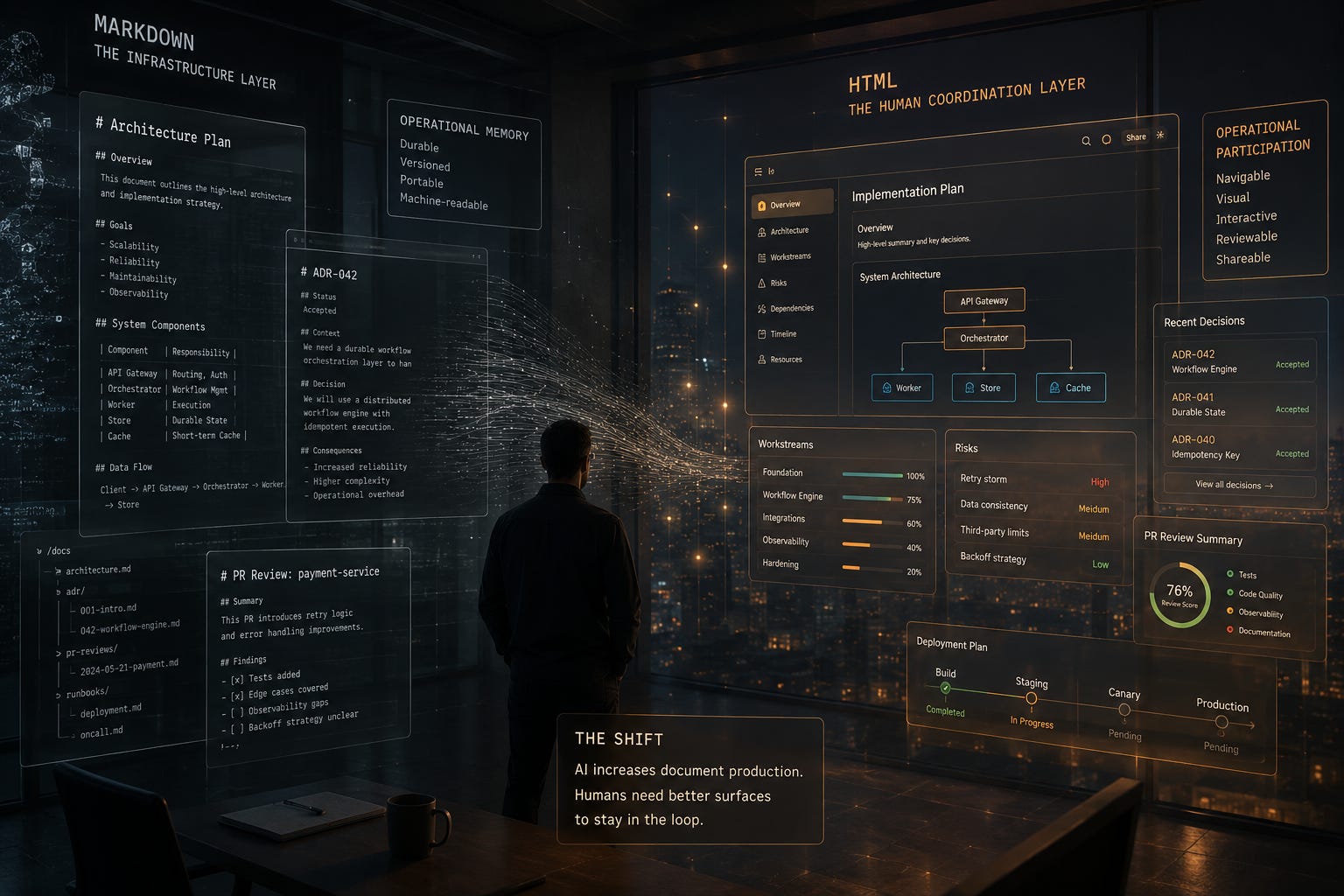
Markdown remains the durable infrastructure layer. It is where operational memory should live. It is portable, version-controlled, machine-readable, token-efficient, and easy to retrieve. HTML is emerging as the human coordination layer. It is where complex generated context becomes easier to scan, review, present, and discuss.
That distinction matters. Markdown stores the system’s memory. HTML improves human participation. This is similar to the difference between a database and a dashboard. The dashboard does not replace the database. It makes the data usable for decision-making. The same pattern may now be emerging in AI work.
Markdown remains the source layer. HTML becomes the surface layer. The enterprise value is not that HTML can draw a better chart. The value is that HTML can help humans stay in the loop when the amount of generated context becomes too large for linear review.
Disposable Interfaces Are Becoming Economically Rational
This may be the largest shift underneath the entire discussion.
AI is reducing the cost of interface generation so dramatically that organizations can start building software that only exists temporarily.A migration plan may come with its own generated dashboard. A complex PR may come with its own explainer surface. A feature rollout may come with a temporary risk-review interface. A design-system update may come with a navigable visual artifact. A product decision may come with a generated comparison tool.
Historically, these tools would not exist. They would be too expensive to build and too narrow to justify. Now the economics are different. If a generated interface helps three people understand a complex decision faster, it may already be worth the compute.
That is the new trade-off.
The cost of producing internal software is falling. The cost of misunderstanding complex work remains high. This is why the HTML shift matters. It points toward an enterprise environment where temporary software becomes a normal part of planning, review, and coordination.
But that also creates risk.
If every team starts generating disposable operational interfaces, organizations will eventually face a new kind of sprawl. Thousands of generated artifacts. Inconsistent review flows. Unclear ownership. Security questions around scripts. Auditability issues. Knowledge scattered across temporary surfaces.
The cheaper software generation becomes, the more valuable operational discipline becomes.
The Compute Incentive Is Real
There is also a fair devil’s advocate argument.
HTML costs more than markdown. It usually requires more tokens, richer structure, more rendering, and more iteration. If agents generate more HTML artifacts, model providers benefit from higher compute consumption.
That incentive is real. Frontier AI labs are not neutral observers in this shift. They are infrastructure businesses. They benefit when workflows use larger context windows, longer sessions, richer artifacts, and more persistent agentic loops.
So yes, there is a business incentive to normalize higher-compute workflows.But that does not make the shift fake.Most computing transitions expanded resource consumption before they became normal. Graphical interfaces consumed more than terminals. Rich web apps consumed more than static pages. Cloud architectures consumed more than single-server deployments. Video consumed more than text.
The question is not whether HTML costs more. It does.
The question is whether the extra cost buys better comprehension, better review, and better coordination.In some workflows, it will not. Markdown will be enough.
In complex enterprise workflows, the answer may increasingly be yes.
The Manager Becomes a Compute Allocator
This also changes the role of management.
In a traditional software organization, managers and product leaders allocate people, budget, roadmap priority, and review attention. In an AI-native organization, they also allocate inference.
That sounds abstract, but it is practical. A long-running agent working across a large codebase is not free. Asking it to explore multiple solution paths, generate mockups, build review artifacts, verify assumptions, and produce implementation plans has a real cost.
So the managerial question changes.
It is no longer just, “What should the team work on?”
It becomes, “Where is it worth spending machine cognition, and where does human judgment need a better interface?”
That is why specs still matter. PRDs still matter. Architecture plans still matter.
They are no longer just documents for humans. They are coordination boundaries for agents. And if those boundaries are too hard for humans to review, the organization loses control over the work. HTML is useful because it can make those boundaries visible.
Markdown Is Not Dying
Markdown is not dying. Markdown is becoming the operational memory layer for AI work.
It should remain the place for prompts, source-of-truth specs, ADRs, changelogs, machine-readable instructions, repo-level context, and long-term documentation. It is still the cleanest format for storage, versioning, retrieval, and model ingestion.
HTML belongs somewhere else.
HTML is the human layer. It is for review, onboarding, exploration, presentation, and coordination. It is useful when the artifact has become too complex to be consumed as a linear document.
The strongest workflow is not HTML versus markdown.It is markdown plus HTML.
Markdown for memory. HTML for participation.
That is the clean enterprise framing.
Implications
The first implication is that documentation strategy will become more layered. Companies that treat every artifact the same way will create chaos. Some files should be durable, plain, version-controlled, and machine-readable. Others should be generated, visual, interactive, and temporary.
The second implication is that internal tooling may become more disposable. Teams will generate lightweight interfaces around specific decisions instead of waiting for centralized platforms to support every workflow. That will improve speed, but it will also create governance pressure.
The third implication is that review culture becomes more important, not less. AI can generate plans, but humans still need to understand trade-offs. If HTML gets more people to read, comment, and catch mistakes, it has real operational value.
The fourth implication is that compute economics will become part of enterprise management. Richer artifacts are useful, but they are not free. The organizations that win will not be the ones that generate the most. They will be the ones that know where richer agentic workflows are worth the cost.
Conclusion
The important shift is not formatting. It is coordination. AI systems are increasing operational output faster than human organizations can absorb it. That changes the optimization target.
Before AI, the expensive part was generating documentation. After AI, the expensive part is keeping humans meaningfully in the loop.
Markdown solved storage. HTML may help solve participation.
That is why this trend matters. Not because markdown failed. Not because HTML is new. But because AI has created a world where producing context is easy and consuming it is hard. In that world, the human layer becomes infrastructure too.