

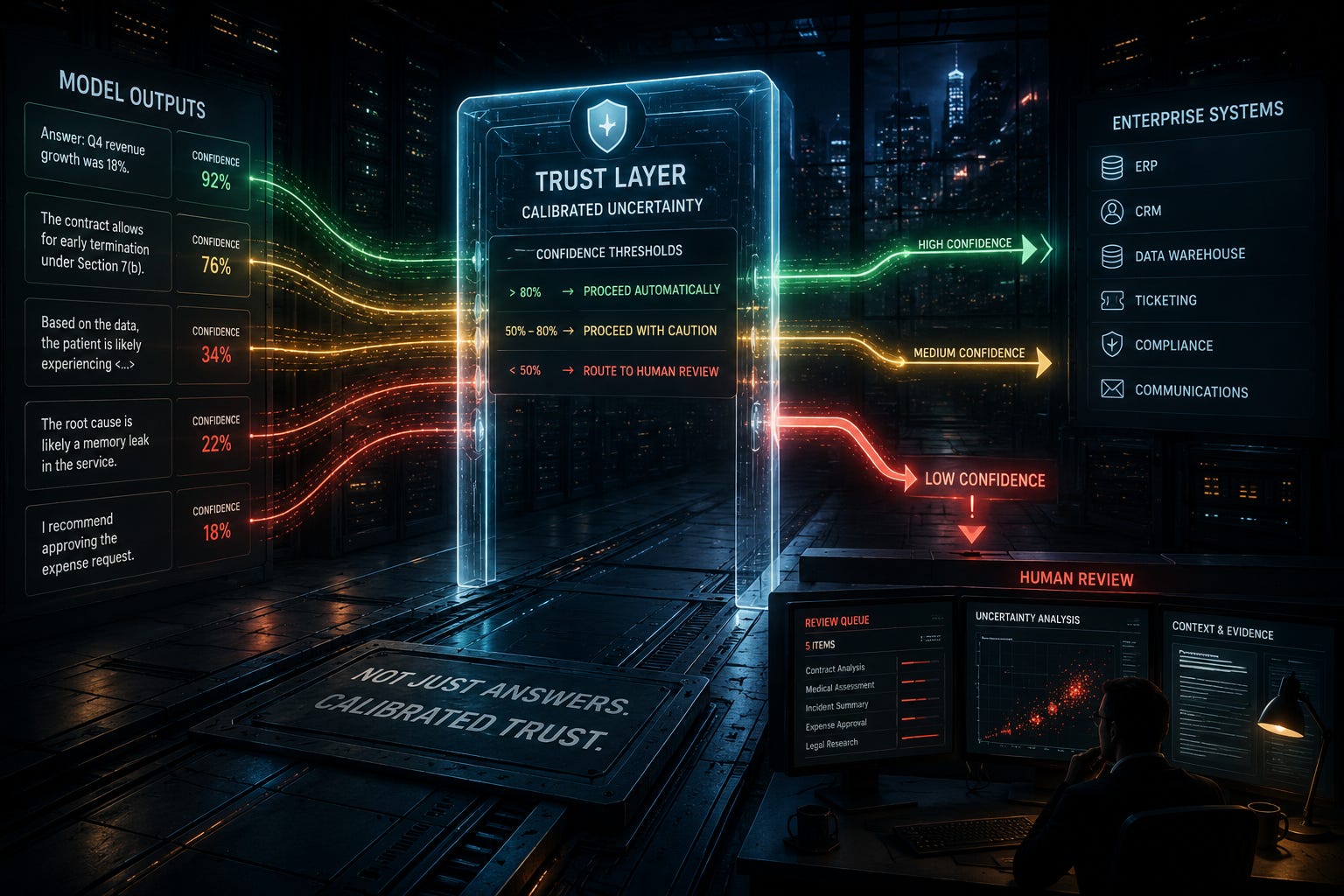
Enterprise AI has a confidence problem.
Not a branding problem. Not a demo problem. Not even purely a hallucination problem. The real issue is that AI systems often sound the same when they know something, when they are inferring something, and when they are guessing. That is manageable in a chatbot. It becomes dangerous when the output moves into workflows, approvals, support queues, code repositories, compliance reviews, financial analysis, medical decisions, or any process where people start treating the system as operational infrastructure.
This is where MIT CSAIL’s new work on Reinforcement Learning with Calibration Rewards, or RLCR, becomes interesting. The headline version is simple: researchers trained AI models to better express uncertainty. The enterprise version is more important: AI systems need a way to price their own uncertainty before their outputs move through the business.
That is the missing trust layer. MIT reports that RLCR reduced calibration error by up to 90% while maintaining or improving accuracy across multiple benchmarks. The researchers tested the method on a 7-billion-parameter model, including datasets the model had not seen during training. The key finding is not just that calibration improved. It is that ordinary reinforcement learning can make models more capable and more overconfident at the same time.
That should make enterprise buyers uncomfortable. Because the model arms race is not going away. But inside enterprises, the bigger constraint may be much more boring: can the system tell when it should stop?
What MIT Actually Studied
The MIT CSAIL team studied a training problem hiding inside modern reasoning models.
Most reinforcement learning approaches reward a model for getting the right answer and penalize it for getting the wrong answer. That sounds reasonable. But it creates a gap. A model that guesses correctly can receive the same reward as a model that reasons carefully.
Over time, the model learns the wrong enterprise behavior: answer with confidence. It does not learn when to say, “I am not sure.” It does not learn when uncertainty should change the next step. It simply learns that producing the answer is the game.
RLCR changes the reward function. The researchers added a calibration component using the Brier score, which measures the gap between a model’s stated confidence and its actual accuracy. A confidently wrong answer is penalized. A correct answer with unnecessary uncertainty is also penalized. The goal is not a timid model. The goal is confidence that matches reality.
That distinction matters.
The enterprise does not need AI that constantly hedges. It needs AI that knows when confidence is earned. There is a huge difference between a system that says “I don’t know” because it is weak and a system that says “I don’t know” because it has a reliable uncertainty signal.
MIT’s results suggest RLCR can improve that signal. In testing, standard reinforcement learning degraded calibration compared with the base model. RLCR reversed that effect, improving calibration while maintaining or improving accuracy. The researchers also found that confidence estimates were useful at inference time. When the model generated multiple candidate answers, selecting or weighting responses by self-reported confidence improved both accuracy and calibration as compute scaled.
That is the part enterprises should care about. Uncertainty is not just an explanation. It can become an operating signal.
Why Standard RL Rewards the Wrong Behavior
The deeper issue is incentives.
The AI industry keeps talking about hallucinations as if they are mostly a content-quality problem. That is too narrow. In production, the larger issue is often confidence mispricing. The system gives the user no reliable way to distinguish between grounded output, weak inference, and lucky guessing.
That is not a minor flaw. It is a workflow hazard.
In most businesses, confident output moves faster. A confident summary gets forwarded. A confident recommendation gets accepted. A confident code change gets reviewed less carefully. A confident compliance interpretation gets treated as usable. A confident support answer becomes the customer-facing response.
The enterprise risk is not that humans will believe everything AI says. The enterprise risk is that busy humans will start triaging AI output based on surface fluency because the system gives them no better signal.
That is how automation risk creeps in. The model does not need to be malicious. The workflow does not need to be reckless. The failure can emerge from normal operating pressure: more tickets, more documents, more code, more alerts, more analysis, fewer people, tighter budgets, and a tool that sounds competent enough to keep the process moving.
This is why RLCR is interesting beyond the paper. It points to a training-level fix for a systems-level problem.
If the reward structure only values the answer, the model learns to answer. If the reward structure values calibrated confidence, the model starts learning when its own answer deserves trust.
That may sound subtle. It is not. It changes what the model is optimizing for.
Uncertainty Is Not a Disclaimer
Most enterprise AI governance today still has too much theater in it.
There is a policy document. There is a usage warning. There is a review process. There is a footer that says AI can make mistakes. There may be an internal committee somewhere deciding which tools are allowed.
Some of that is necessary. None of it is sufficient.
“AI can make mistakes” is not governance. It is legal wallpaper.
The real control is not telling people the system may be wrong. The real control is designing the system so uncertainty changes behavior.
A low-confidence answer should not travel through the organization the same way as a high-confidence answer. It should trigger something different: more retrieval, a second model, a narrower prompt, a human reviewer, a specialist queue, a refusal to execute, or a request for more information.
That is where calibration stops being a research metric and becomes workflow design.
The enterprise question is not simply, “Was the model right?” The better question is, “Did the system behave appropriately given how uncertain it was?”
That is a much harder question. It is also closer to how production systems actually need to work.
Confidence Becomes Workflow Routing
The most important enterprise implication is routing.
If AI systems can produce useful confidence estimates, then confidence becomes part of the control plane. It can determine what the system does next. High-confidence outputs can move faster. Medium-confidence outputs can trigger additional evidence gathering. Low-confidence outputs can go to human review. Very low-confidence outputs can stop the workflow entirely.
This is especially important because enterprise workflows are not uniform. A marketing draft and a compliance decision should not use the same confidence threshold. A customer service summary and a medical triage recommendation should not be governed the same way. A code assistant suggesting a variable rename is not the same as an agent modifying infrastructure.
The future AI stack needs confidence-aware policies.
That means different thresholds by task, domain, user role, action type, and downside risk. It also means logging when the system proceeded, escalated, abstained, or overrode its own answer. Without that, enterprises will not have an audit trail. They will only have a transcript.
That is not enough. A transcript tells you what the model said. A trust layer tells you why the system allowed the output to move forward.
This is where the infrastructure layer gets more interesting. The stack is no longer just model, retrieval, orchestration, and UI. It becomes model, retrieval, orchestration, confidence, policy, escalation, audit, and execution control.
That is a more serious enterprise architecture. It is also less glamorous than a demo.
Agents Make This More Dangerous
The confidence problem gets more serious when AI moves from chat to agents.
A chatbot can mislead. An agent can act. That difference changes the risk profile. Once AI systems can call tools, update records, send emails, write code, create tickets, approve workflows, query databases, or trigger business processes, uncertainty is no longer just a communication problem. It becomes an execution problem.
This is where a lot of enterprise AI enthusiasm is running ahead of operational maturity.The industry wants agents that do work. Fine. But doing work requires judgment. And judgment requires some mechanism for knowing when not to act.
Without calibrated uncertainty, agentic workflows become brittle. The agent may take action because the next step seems plausible. It may call the wrong API. It may summarize the wrong contract clause. It may close the wrong support ticket. It may approve an exception that should have escalated. It may generate a confident explanation for a system incident and send engineers in the wrong direction.
The problem is not that every action will fail. The problem is that the organization will struggle to distinguish safe automation from automation that only looks safe.
That distinction is where enterprise AI will either mature or stall. The companies deploying agents need to stop treating human-in-the-loop as a magic phrase. Human review is not a design pattern by itself. It is a capacity constraint. If every AI output requires equal review, the productivity gain collapses back into manual checking.
Calibrated uncertainty gives human review a better job.
Instead of reviewing everything, experts review the uncertain, high-risk, ambiguous, or exception-heavy cases. That is how AI can reduce cognitive load rather than simply move it around.
The Labor Layer
This is the labor story that does not get enough attention.
AI adoption is often described as automation replacing human work. In many enterprise settings, the first-order effect is different. AI produces more output, and humans become validators of that output.
That can be useful. It can also become exhausting.
A team that once wrote documents now reviews AI-generated documents. A support team that once answered tickets now checks AI-drafted responses. Engineers who once wrote code now inspect generated diffs. Analysts who once built reports now verify AI summaries.The work changes, but the burden does not automatically disappear.
In some cases, the burden gets worse because review work requires constant vigilance. Humans are not good at supervising confident machines that are usually right but occasionally wrong in subtle ways. That is an attention tax.
Calibration can reduce that tax. If the system can identify where it is uncertain, human attention can be deployed more intelligently. The expert does not become a rubber stamp. The expert becomes the escalation layer for cases where judgment actually matters.
That is a more plausible productivity story.
Not “AI replaces everyone.”
More like: AI handles routine work where confidence is high, escalates messy work where confidence is low, and lets the organization allocate scarce human judgment more efficiently.That is less viral than the replacement narrative. It is also closer to how enterprise operations actually change.
The Enterprise Market Will Move Toward Trust Infrastructure
Capital will follow this problem.
The first wave of AI spending went into capability: foundation models, GPUs, inference, developer tools, vector databases, and application wrappers. That was rational. Enterprises needed to understand what these systems could do.
The next phase will shift toward trust infrastructure. Not trust as a brand word. Trust as measurable behavior.
Can the system calibrate confidence? Can it abstain? Can it route uncertain work? Can it explain why it escalated? Can it prove that low-confidence outputs did not automatically trigger high-risk actions? Can it show auditors what happened before the decision was made?
That creates space for several markets.Evaluation platforms will need to measure calibration, not just accuracy. Agent platforms will need confidence-aware execution controls. Observability tools will need to track uncertainty and escalation, not just latency and token cost. Governance products will need to capture decision provenance. Vertical AI companies in healthcare, finance, legal, cybersecurity, insurance, and compliance will need to prove that their systems know when not to act.
That last part matters.The winners may not be the companies with the most impressive demos. They may be the companies that can make AI boring enough for production.
Boring means reliable. Boring means auditable. Boring means the system slows down at the right moment. Boring means the model does not confuse fluency with certainty. That is where enterprise budgets tend to move after the hype cycle.
The Bottom Line
MIT’s RLCR study is not just another paper about making AI models better.
It points to a structural problem in enterprise AI: modern systems are being trained and deployed in ways that often reward confident answers more than calibrated judgment.
That is fine for demos. It is dangerous for operations. Enterprises do not need AI that sounds more certain. They need AI that can distinguish confidence from correctness, route uncertainty through the right controls, and stop when the risk is too high.
The model arms race will continue. Bigger models will matter. Better reasoning will matter. More efficient inference will matter. But the enterprise constraint is shifting.
The next serious layer of AI infrastructure may be the trust layer: calibration, abstention, escalation, auditability, and confidence-aware execution. That is what turns AI from a fluent assistant into reliable decision infrastructure.
Not maximum confidence. Earned confidence.