


Texas is powering the future literally. Between AI data centers, electric vehicles, and new factories, the state’s electricity use is rising faster than nearly anywhere else in the country.
But while utilities are rushing to build new power lines and substations to handle this growth, local cities and homeowners are pushing back against higher electric bills. That push-and-pull is shaping not just the price of electricity, but also the reliability of the Texas grid itself.
This growing tension between investment and affordability is now playing out in North Texas, where a major rate case could set the tone for how Texas and the nation balances growth with fairness.
The Bigger Picture
Across the U.S., utilities are refocusing on what they call “demand hotspots” areas where energy use is exploding because of data centers and advanced manufacturing.
A recent analysis from McKinsey & Company projects that U.S. grid investment will climb about 23% between 2025 and 2030, driven largely by this wave of power-hungry development.
Each rack of AI servers can draw 30 to 100 kilowatts of power roughly the same as several homes combined making data centers some of the most energy-intensive facilities ever built.
Utilities are responding with massive capital plans:
CenterPoint Energy, based in Houston, has lifted its 10-year investment plan to around $52.5 billion.
AEP, another major U.S. utility, just secured a $1.6 billion federal loan guarantee to upgrade transmission lines.
The World Resources Institute cautions that if grid expansion lags behind new demand, ordinary consumers could face higher rates or reliability problems, especially during extreme weather.
In short: the nation’s power grid is being rebuilt around where energy demand is going not where it used to be. And that creates both opportunity and friction.
North Texas: Where the Tension Is Rising
Here in North Texas, the national story has become local.
On June 26, 2025, Oncor Electric Delivery, the state’s largest power-line operator, filed for a $834 million base-rate increase about a 13% boost over current revenues. The company said the money would go toward building new substations, replacing aging equipment, and upgrading transmission lines to serve fast-growing industrial zones and data-center clusters north of Dallas.
For the average home using 1,000 kilowatt-hours per month, that would mean roughly $7.90 more on the monthly bill.
In response, a series of city councils quickly said no.
Plano voted on October 13 to reject the rate increase.
Prosper followed on October 14.
Arlington joined in on October 15.
These local resolutions set up a larger fight involving the Steering Committee of Cities Served by Oncor and the Public Utility Commission of Texas (PUCT), which will now negotiate the outcome.
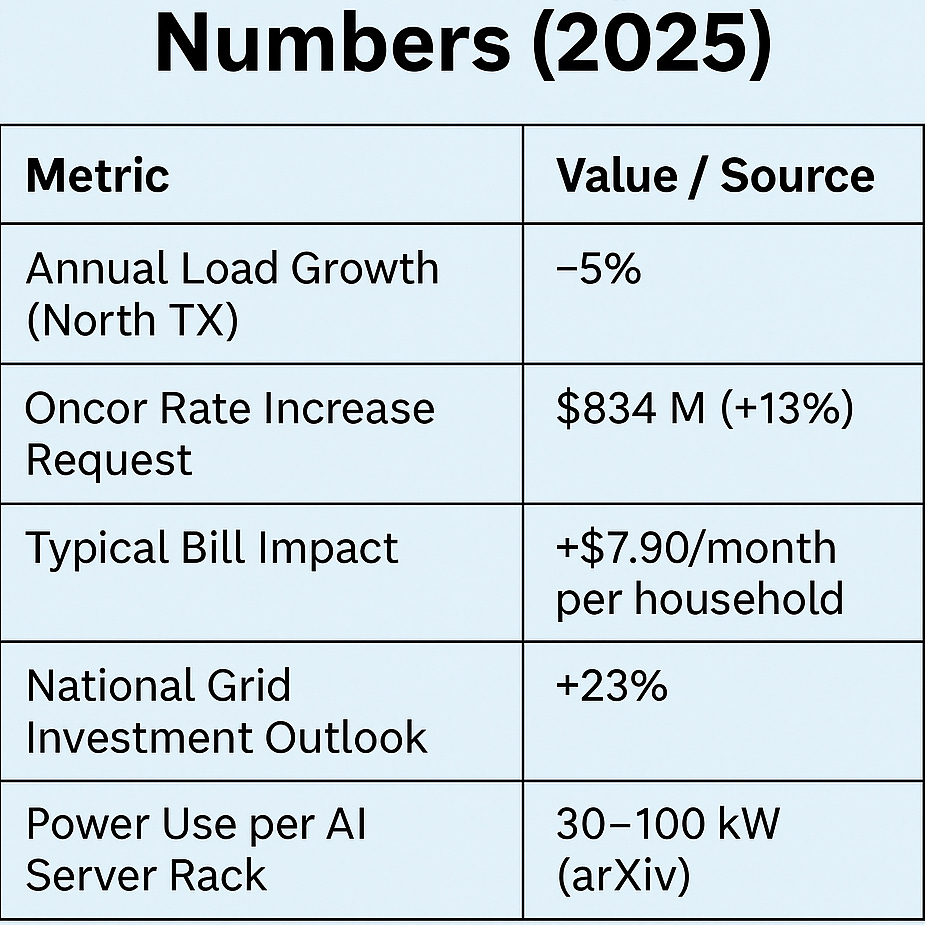
Numbers Tell the Story
Oncor’s request isn’t small change. It represents one of the biggest rate filings in Texas this decade a sign of how fast infrastructure costs are climbing. The company argues that expanding the grid is no longer optional. North Texas electricity demand has been growing around 5% a year, according to ERCOT data, driven by new data centers and industrial parks along Highway 121 and U.S. 75.
Utility engineers say the projects are needed to prevent bottlenecks that could limit growth or trigger local outages. But city leaders see a different problem: they don’t want residential ratepayers subsidizing billion-dollar tech campuses.
Why the Push-Back Matters
Cities like Plano, Prosper, and Arlington aren’t just rejecting a single rate hike they’re sending a message. They want state regulators to make sure the costs of serving new industrial users are shared fairly and not dumped onto homeowners or small businesses.
Their formal resolutions mean that all these cities now enter joint negotiations through the Steering Committee, which represents dozens of municipalities served by Oncor. Together, they’ll push for smaller increases, carve-outs for vulnerable ratepayers, or tiered pricing that scales with energy intensity.
The outcome of this case will ripple far beyond North Texas. It could set the tone for how other utilities in Houston, Austin, and even outside Texas balance massive capital needs with public resistance to rising bills.
The Trade-Off No One Likes
Both sides have valid points.
Utilities argue that without these upgrades, the system will strain under the weight of Texas’s booming population and business growth. AI data centers, EV charging, and manufacturing electrification are all consuming far more energy than previous forecasts predicted.
Cities and consumers, meanwhile, worry that utilities are over-spending or over-building and passing the bill along. Residents remember the blackouts of 2021 and wonder why so much investment is needed if reliability hasn’t improved equally.
The truth lies somewhere in the middle: Texas can’t grow without upgrading its grid but that growth must be managed fairly.
The Real Risk: Delaying the Build-Out
Blocking every rate hike might sound like standing up for taxpayers, but it could backfire.
If utilities don’t have the funds to move forward, projects can be delayed and that means:
Higher future costs. Construction and materials are getting pricier every year. Waiting two years could make the same project 20–30% more expensive.
Reliability risks. When the next heat wave hits and every air-conditioner and server farm spins up, weak spots in the grid become dangerous.
Lost growth. Companies looking to build new facilities may look elsewhere if the grid can’t guarantee power capacity.
Experts warn that postponing investment today could lead to bigger rate shocks later. In simple terms: if you don’t pay now, you’ll pay more and maybe in the dark.
Looking Ahead
Texas has long prided itself on an independent, self-reliant grid. But independence comes with responsibility. To stay ahead of the AI and manufacturing boom, the state must balance growth, fairness, and foresight.
For local governments, the challenge isn’t just whether to approve higher rates it’s how to design smarter ones. Tiered or “demand-based” rates that make industrial users pay more for the strain they cause could protect regular consumers while still funding vital upgrades.
The energy future is arriving faster than anyone expected. The next few years will determine whether Texas leads that future or scrambles to keep the lights on.
Bottom Line
The fight over Oncor’s rate case is about more than a few extra dollars on an electric bill. It’s a preview of how every community in America will wrestle with the cost of powering a digital, electrified, always-on economy.
Texas’s edge has always been its ability to build fast. But if the political will to invest dries up, the next storm or summer surge could remind everyone why infrastructure isn’t optional.